
When most people think about a truck accident claim, they assume there is a single insurance policy that covers the damages. Unfortunately, truck accident cases are rarely that simple. Unlike a typical passenger vehicle collision, commercial trucking accidents often involve multiple insurance policies, several companies, and layers of coverage that can make the claims process extremely complex.
For victims injured in truck accidents throughout the State of Georgia, understanding how commercial trucking insurance works can help explain why these cases often take longer to investigate and resolve than ordinary car accident claims.
At Brandon Smith Law, we regularly help individuals and families navigate the complicated insurance issues that arise after serious truck accidents. Whether a crash occurs on Interstate 75, Interstate 85, Interstate 20, or a rural Georgia highway, uncovering all available insurance coverage is often one of the most important steps in pursuing full compensation.
Why Truck Accident Insurance Is Different Than Car Insurance
In a typical Georgia car accident, there may be only one insurance company involved. The at-fault driver usually carries a personal auto policy with liability coverage that pays for injuries and property damage up to the policy limits.
Commercial trucking accidents are different because trucks are businesses on wheels.
A tractor-trailer may involve:
The truck driver
The trucking company
The trailer owner
A freight broker
A shipping company
A maintenance contractor
A leasing company
Each of these entities may carry separate insurance policies. In some cases, several policies may apply to a single crash. As a result, determining which insurance company is responsible—and how much coverage is available—often requires a detailed investigation.
Understanding Commercial Truck Insurance Minimums
Federal law requires many commercial motor carriers operating in interstate commerce to maintain substantial liability insurance coverage. For most trucks hauling non-hazardous freight across state lines, the minimum liability requirement is $750,000. Trucks transporting certain hazardous materials may be required to carry between $1 million and $5 million in coverage.
However, these figures represent minimum requirements—not necessarily the total insurance available.
Many trucking companies purchase significantly higher coverage limits because a single catastrophic accident can result in millions of dollars in damages. Severe injuries, traumatic brain injuries, spinal cord injuries, permanent disabilities, and wrongful death claims can quickly exceed basic policy limits.
This is where insurance layers come into play.
What Are Insurance Layers?
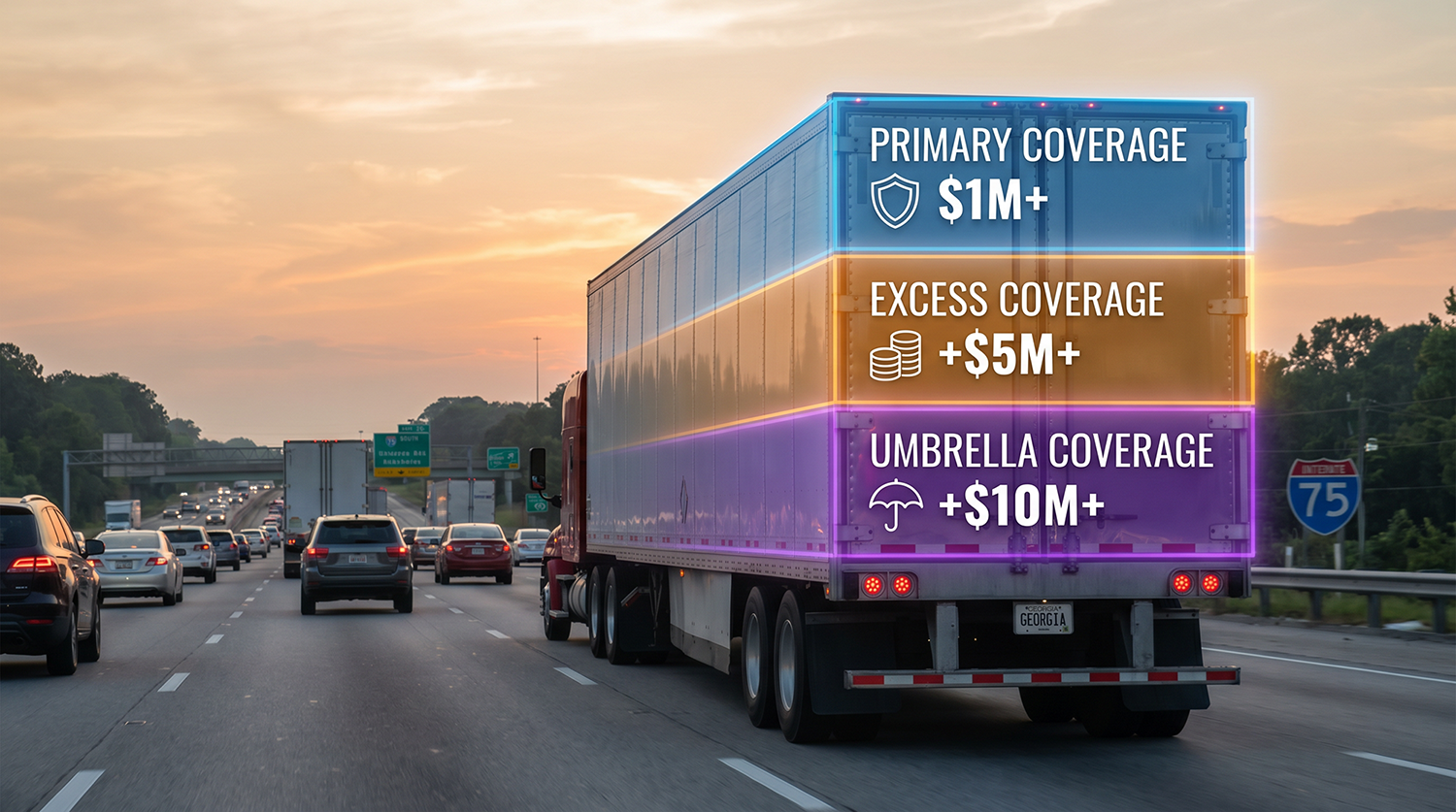
Insurance layers refer to multiple levels of insurance coverage that may apply to a commercial trucking accident.
Think of insurance coverage like a stack of safety nets. If one layer becomes exhausted, another layer may provide additional protection.
Common insurance layers in Georgia truck accident cases include:
Primary Liability Coverage
Primary liability insurance is the first layer of protection.
This policy generally responds first when a trucking company or driver is found responsible for causing an accident. It pays covered damages up to the policy limits.
For example, if a trucking company carries a $1 million primary liability policy, that policy typically pays first before any other coverage becomes available.
Excess Liability Coverage
Excess insurance provides additional coverage once the primary policy limits have been exhausted.
Many medium-sized and large trucking companies purchase excess policies ranging from $1 million to $5 million or more. These policies are designed to protect against catastrophic losses that exceed the primary coverage.
For example:
Primary policy: $1 million
Excess policy: $4 million
If damages exceed the first $1 million, the excess policy may provide an additional $4 million in coverage.
Umbrella Policies
Umbrella policies sit above primary and excess coverage and can provide even broader protection.
Large trucking corporations often carry umbrella policies because they face significant financial exposure from major accidents. These policies can sometimes provide millions of dollars in additional coverage beyond other insurance layers.
Finding umbrella coverage often requires aggressive investigation because insurers do not always volunteer information about every applicable policy.
Multiple Insurance Companies May Be Involved
One reason truck accident claims become complicated is that multiple insurers may share responsibility.
For example, imagine a collision involving:
A truck driver employed by a motor carrier
A trailer owned by another company
Cargo loaded by a third-party logistics company
If improper loading contributed to the crash, the cargo company may have its own insurance policy.
If poor maintenance caused a brake failure, a maintenance contractor may have separate liability coverage.
As a result, there may be several insurance companies defending the claim at the same time.
Each insurer will typically try to minimize its own financial exposure, which can create disputes about who is responsible for paying damages.
The Role of Freight Brokers and Third Parties
Modern trucking operations are often more complicated than many people realize.
The company name displayed on the truck may not be the only business involved in transporting the load.
Freight brokers frequently coordinate shipments between trucking companies and customers. Leasing companies may own the equipment. Independent contractors may operate under another company's authority.
When a serious accident occurs, attorneys must identify every potentially liable party and determine what insurance coverage may be available through each entity. Recent industry discussions have highlighted how brokers, carriers, and other entities can all become involved in trucking accident litigation.
This level of investigation is often necessary to uncover the full amount of compensation available to injured victims.
Why Insurance Companies Fight Truck Accident Claims
Truck accident cases often involve substantial financial exposure.
Because commercial policies frequently carry higher limits than personal auto policies, insurers have a strong incentive to dispute claims.
Common insurance company tactics include:
Arguing the truck driver was not at fault
Blaming another motorist
Disputing the severity of injuries
Challenging medical treatment
Delaying investigations
Contesting which policy applies
Disputing whether excess coverage has been triggered
When millions of dollars may be at stake, insurance companies often deploy teams of adjusters, investigators, accident reconstruction experts, and defense attorneys immediately after a crash.
This is one reason truck accident claims can become significantly more complicated than standard car accident cases.
Why Policy Limits Matter
Insurance policy limits can dramatically affect the value of a claim.
Imagine a crash that causes:
Multiple surgeries
Long-term rehabilitation
Permanent disability
Lost earning capacity
Ongoing medical care
Damages may easily exceed several million dollars.
If only minimum coverage is available, recovering full compensation may be difficult. However, if additional layers of excess and umbrella coverage exist, substantially more compensation may be available.
Identifying every applicable insurance policy is therefore a critical part of building a strong truck accident case.
Why Early Investigation Is So Important
Evidence in truck accident cases can disappear quickly.
Electronic logging device data, driver qualification files, maintenance records, dispatch communications, and onboard computer information may all play an important role in determining liability and insurance coverage.
An early investigation can help identify:
The trucking company
The driver
Additional liable parties
Available insurance policies
Excess coverage
Umbrella coverage
Federal regulatory violations
The sooner this information is preserved, the stronger the foundation for a successful claim.
How Brandon Smith Law Helps Georgia Truck Accident Victims
Truck accident insurance claims are often far more complicated than they appear at first glance. Multiple companies, layered insurance policies, excess carriers, and commercial coverage requirements can create challenges that do not exist in ordinary vehicle accident cases.
At Brandon Smith Law, we understand the unique complexities of commercial trucking litigation throughout the State of Georgia. Our team investigates trucking companies, insurance policies, regulatory compliance records, and all potentially liable parties to identify every available source of compensation.
Whether a crash occurred in Atlanta, Savannah, Macon, Augusta, Columbus, Valdosta, Athens, or anywhere else in Georgia, Brandon Smith Law works to uncover the full picture behind a truck accident claim.
When insurance companies focus on protecting their bottom line, injured victims deserve an advocate who understands how trucking insurance really works and how to pursue the compensation they may be entitled to recover.
